
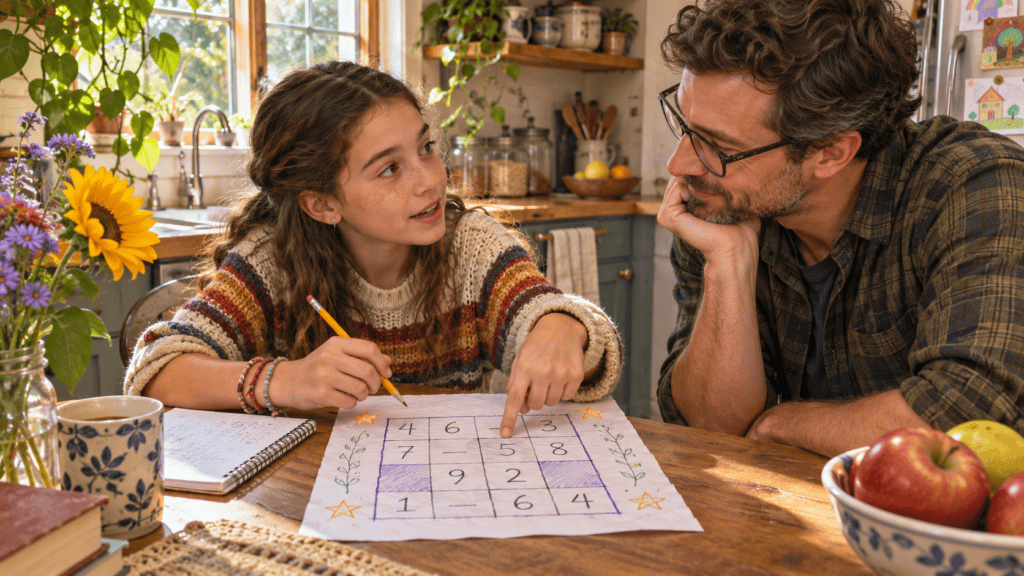
Your child has read the clue twice. The pencil stops moving. Then comes the question: “Can you just tell me?” It is a familiar moment during a paper puzzle, a mystery game or a family escape adventure. You want to keep the activity enjoyable, but you also want the discovery to belong to your child.
You do not need a perfect speech. Try offering one small hint, then leaving room for a new attempt. This practical approach is for parents and teachers playing with children ages 8–12. Adjust the help to the child and the moment; finishing independently is not a requirement for having fun.
Start by finding out what is difficult
Before pointing to the answer, ask your child to show you what they have tried. They may understand the puzzle but have missed one word. They may have a good idea and need reassurance. Or the instructions themselves may be the obstacle.
Try: “Tell me what you think the clue means.” Listen before adding another question. If reading is taking all their attention, read the instructions aloud while they follow along. You can support access to the puzzle without solving its central challenge.
Avoid calling the puzzle easy. That description does not help someone who is finding it difficult. A more useful response is: “Let’s look at one part together.”
Use a simple hint ladder
First hint: point back to the evidence
Ask a question that helps the child return to the page: “Which clues have we used?” or “What information do we know for certain?” Keep the question specific enough to be useful. Repeating “Think harder” gives no direction.
After the prompt, pause. Let the child mark the page, move a card or explain a possibility. Several questions in a row can turn a helpful conversation into another task to keep track of.
Second hint: name the useful action
If the first prompt does not help, suggest an action rather than a result. For an ordering puzzle, try moving labelled scraps of paper. For a code, compare the symbols with the key. For a word clue, underline the instruction that tells the player how to read it.
You might say: “Try placing the card we know first.” This gives the child a way to begin while leaving the remaining decisions open.
Third hint: work through one step together
Sometimes a more direct example is the kindest next move. Solve one small part aloud, explaining your reason, then invite the child to continue. Say what you are doing clearly: “I’ll help with this step, and then we can try the next one together.”
There is no need to hide adult help or treat it as a failed attempt. If the child wants the answer, you can explain it and move on. The goal of a family puzzle session is a shared activity, not a test.
Try the approach with this original mini-puzzle
Write these clues on a sheet of paper:
Three keys sit in a row: a brass key, a silver key and a wooden key. The brass key is immediately to the left of the wooden key. The silver key is not at either end. What is the order from left to right?
Pause here before reading the answer. This is a standalone DIY puzzle, not a sample from a Printed Adventures product.
A correction can be part of the investigation
This particular set of clues has no solution. Silver must occupy the middle, but brass and wood must be adjacent. The two remaining end positions are not adjacent. Use this only when you explicitly introduce the challenge as “Can these clues all be true?” It is a chance to check evidence, not a trick to spring on a child who expects an ordinary solvable puzzle.
For a straightforward version, change the second clue to: “The brass key is somewhere to the left of the wooden key.” Now the unique order is brass, silver, wood.
Three hints for the solvable version
Hint one: “Which key has only one possible position?”
Hint two: “If silver cannot be at either end, where must it go?”
Hint three: “Put silver in the middle. Now compare brass and wood using the left-of clue.”
Answer: brass, silver, wood. Silver occupies the middle; brass must be on the left because it comes before wood. Use paper labels if moving objects makes the relationships easier to follow.
Keep group play comfortable
When siblings or classmates play together, one quick answer can end the thinking time for everyone else. Invite each player to consider a clue before the group agrees. You can ask everyone to point to the evidence for their suggestion.
If one child wants more help, quietly offer the next hint rather than announcing who is struggling. In a classroom, prepare hints on folded slips so groups can choose when to open them. Avoid making hints a penalty unless that rule is clearly part of a game everyone wants to play.
Know when to take a break
If the child is tired or upset, offer a choice: one more hint, solve this part together, or pause the activity. You can leave the page on the table and return later. A timer may add excitement for some children, but you can leave it out when it adds pressure.
After a solution, ask a simple question: “Which clue helped most?” Keep the conversation short and curious. You might also invite your child to write a clue for you and become the hint giver.
Choose your next paper adventure
A little preparation helps adults enjoy the story too. Before beginning a printable game, read its own instructions and check any included help materials. Use the guidance for that particular game rather than assuming every printable adventure works in the same way.
Explore story-led printable games at Printed Adventures. For several themes in one purchase, browse the Adventure Bundle. Choose a theme your child is curious about, then keep your role simple: listen, offer a useful nudge, and share the discovery.