
The meal is nearly ready, the adults are talking, and the kids have asked when dinner starts for the fourth time. Give them a small mystery to work on together while everyone gathers.
These Thanksgiving activities for kids ages 8–12 need paper, pencils and a few minutes of adult preparation. The main activity is an original envelope mystery, followed by a drawing challenge and an optional conversation game. Children can stop between rounds when dinner is served. There is no need to turn the whole gathering into a scheduled event.
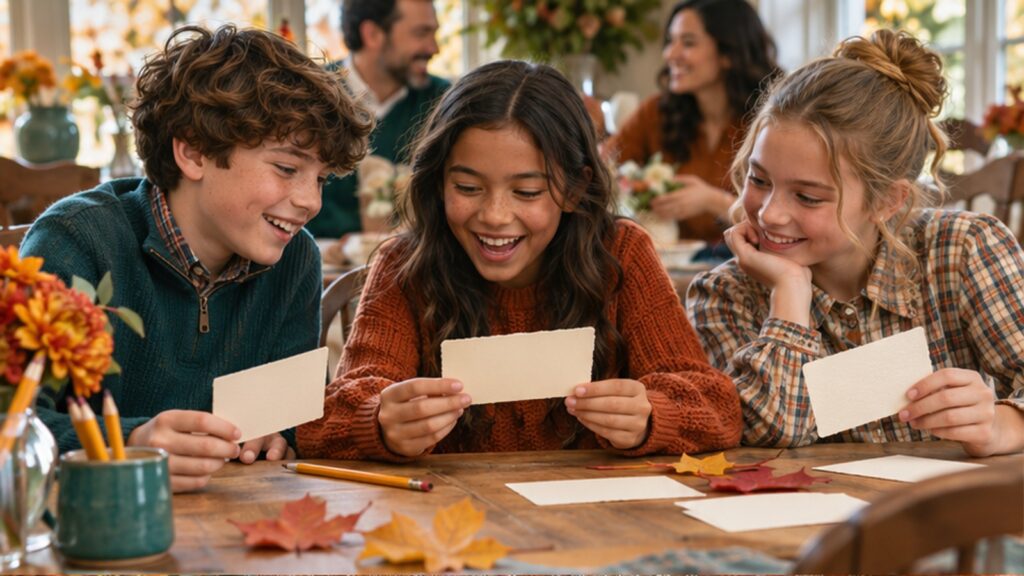
Set up Thanksgiving activities for kids at a separate table
Use a small clear space away from hot dishes and serving traffic. Put out pencils and paper before guests arrive. Keep drinks to one side so a spill does not end the investigation.
Explain that the children are solving a fictional case together. Nobody has really lost anything, and no guest is a suspect. This keeps the mystery playful without sending children searching through someone else’s belongings.
What to prepare
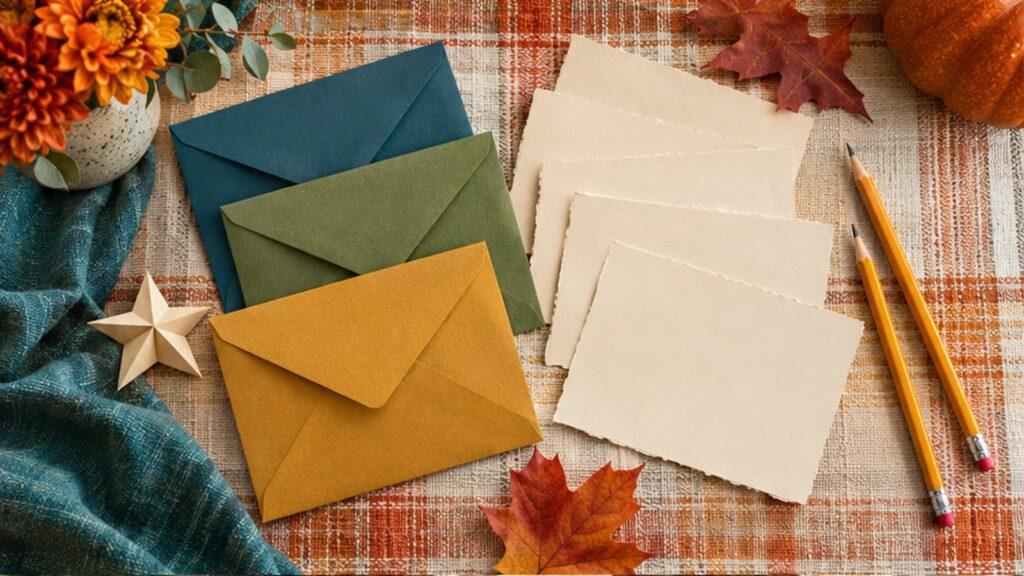
Copy the story and three clues below onto one sheet. Alternatively, write each clue on a separate card. Keep the answer out of sight. Colored envelopes are optional: the puzzle works entirely on paper, including in black and white when the colors are written as words.
For a mixed-age group, let an adult or confident reader read the clues aloud. Younger guests can point to envelope names or draw the final answer. Older children can explain how they ruled out each possibility.
The mystery of the missing welcome star
The family made a paper star for the welcome display. Someone safely tucked it into an envelope before setting the table. Now there are three envelopes: BLUE, GREEN and GOLD. Only one contains the star.
A note explains:
“Exactly ONE of the following three statements is true.”
- BLUE says: “The star is in GREEN.”
- GREEN says: “The star is not in GREEN.”
- GOLD says: “The star is not in BLUE.”
Which envelope contains the star?
How to play fairly
Ask children to test each possible hiding place. They can draw a table with BLUE, GREEN and GOLD as the possible answers, then count how many statements would be true in each case.
If a player guesses, invite them to explain the evidence. The group needs an answer that fits the rule about exactly one true statement, rather than the most popular guess.
For a hint, ask: “What happens to the BLUE and GREEN statements when you choose the same hiding place?” Those two statements contradict each other, so one of them must be true. That means the GOLD statement must be false.
Parent answer: BLUE
If the star is in BLUE, the statements are false, true and false: exactly one is true.
If the star is in GREEN, they are true, false and true: two are true. If it is in GOLD, they are false, true and true: again, two are true. Only BLUE satisfies the rule.
If you use real envelopes, place a paper star in BLUE before the activity. Do not change its location after the children begin. When they solve the case, let them open the envelope and add the star to the welcome display.
Add a place-card design challenge
After the mystery, offer a quieter creative round. Give each child a folded piece of paper and ask them to design a place card for an imaginary guest: a friendly dragon, a traveling explorer or a talking fox.
Each card needs a name, a tiny picture and one clue about the guest’s favorite hobby. The hobby should be suggested by the picture rather than written outright. A telescope might suggest stargazing; a watering can might suggest gardening.
Let someone else interpret the clue
Pass the cards around and ask another player what they think the guest likes doing. Accept more than one sensible interpretation. This is an open drawing activity, unlike the envelope puzzle, which has one correct solution.
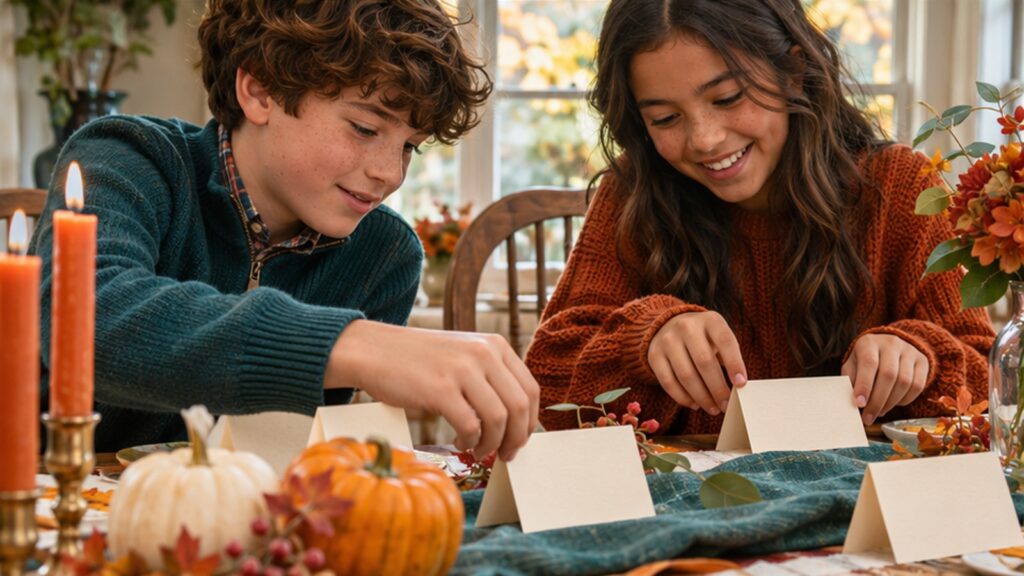
If children want to make real place cards, check names and seating arrangements with the host first. Keep the imaginary version available so nobody has to write for a guest they do not know well.
Try an optional “small good thing” round
Invite each person to name one small thing they enjoyed recently: a funny book, a game with a friend, a rainy walk or a successful drawing. They may draw it, describe it or pass.
Avoid asking children to perform gratitude on demand or to explain a personal experience in front of unfamiliar guests. A light invitation leaves room for different moods and family situations.
For a playful variation, one person draws their small good thing while the others guess. Give the artist the final word about what their picture means.
Make the activities work around the meal
Choose one round first. You can offer another if there is still time, but a complete set of activities is not a requirement for a successful gathering. Save unfinished drawings for after dinner.
For children who want more challenge
Ask them to design their own envelope mystery. They must choose a hiding place, write three statements and test every possible location. Does exactly one location satisfy the rule? If several do, revise the clues before sharing the puzzle.
For a classroom or homeschool group
Use fictional guests and an autumn welcome display instead of a family dinner setting. Children can solve individually, compare reasoning with a partner and explain which possibility they eliminated first. Do not assume every child celebrates Thanksgiving.
For families outside the United States
The envelope mystery also works for an ordinary autumn gathering or a winter-break afternoon. Change the welcome star to a paper leaf or a message. Keep the clue wording and envelope names unchanged unless you also recheck the solution.
Keep a longer adventure for another day
If your children enjoy following clues, Printed Adventures offers story-based printable puzzle games for kids. The collection includes detective, spy, pirate, wizard, ghost and temple themes. Browse together and choose a setting your group enjoys.
For more short activities, explore our screen-free activities for kids ages 8–12 or try code-breaking games for kids.