
Code-breaking games for kids turn ordinary letters into a small mystery. With paper, a pencil, and a clear decoding key, children can uncover a message, check their answer, and create a new challenge for someone else. This activity is designed for ages 8–12, with easier and harder options so you can match the puzzle to your child rather than their age alone.
You do not need to hide clues around the house or prepare a whole escape room. Start with one message at the kitchen table. These three original mini-missions work for an after-school break, a rainy afternoon, or a classroom partner activity. They are standalone activities, separate from the puzzles inside any Printed Adventures product.
What You Need for These Code-Breaking Games for Kids
Gather plain paper, pencils, an eraser, and the decoding keys below. An adult can copy the messages by hand, or print the included activity sheet. Keep the answers on a separate page so children can try each mission before checking their work.
There is no fixed finishing time. Try one short mission first, then continue if the group wants more. Explain that a slash separates words and a dash separates numbers within a word. This keeps the code readable without revealing the answer.
Mission 1: Decode the Meeting Time
Your decoding key
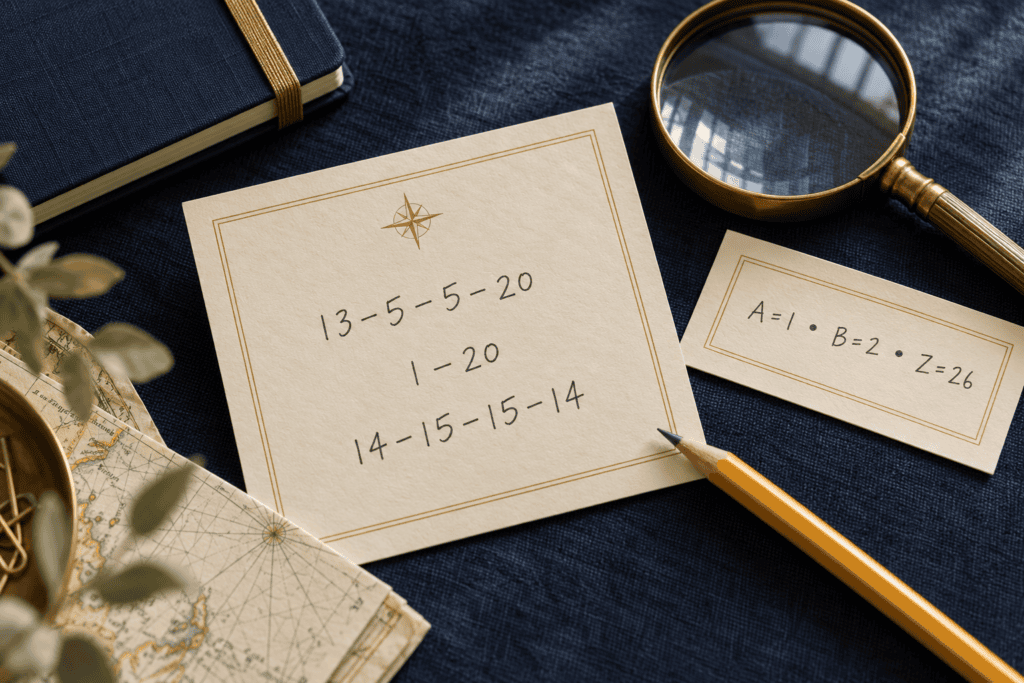
Give every letter its position in the alphabet: A=1, B=2, C=3, continuing to Z=26. Write out all 26 pairs if your child would find that easier than counting through the alphabet.
The secret message
13–5–5–20 / 1–20 / 14–15–15–14
Begin with the first number. Thirteen becomes M, and five becomes E. Write each decoded letter beneath its number. Then read the words together. Ask your child to check each number against the key before deciding the mission is complete.
Answer and a helpful hint
The message is MEET AT NOON. If your child gets stuck, reveal the first word and let them decode the rest. For an extra challenge, ask them to encode MEET AT TEN and compare which parts change.
Mission 2: Flip the Alphabet
Your decoding key
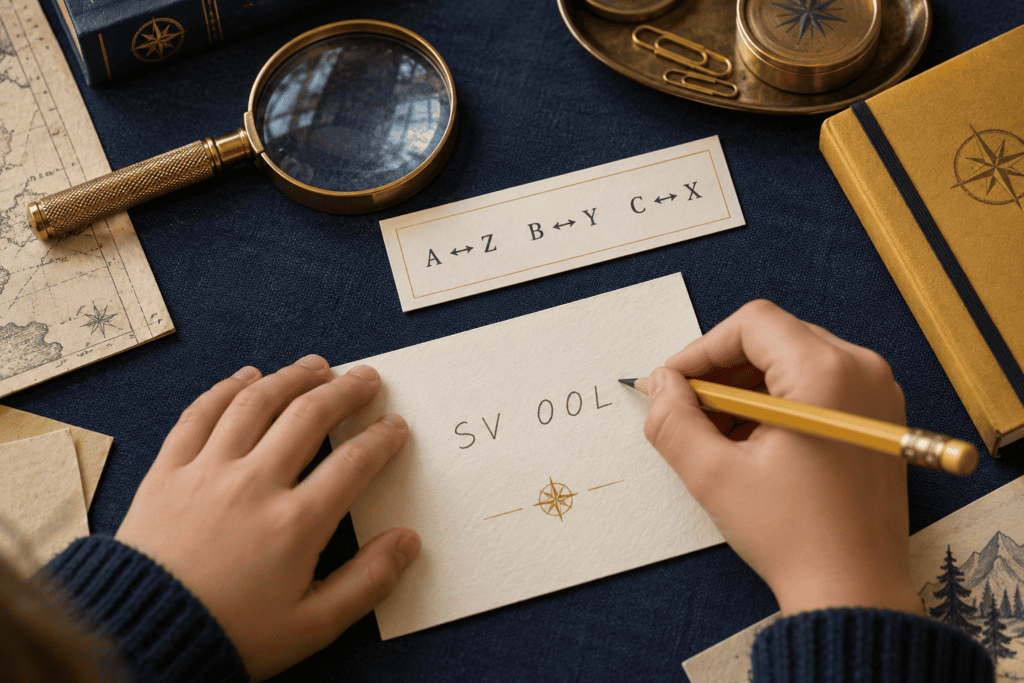
This time, pair the alphabet with its reverse. A matches Z, B matches Y, C matches X, and so on. Write these two rows in aligned columns:
ABCDEFGHIJKLMNOPQRSTUVWXYZ
ZYXWVUTSRQPONMLKJIHGFEDCBA
To decode a letter, find it in the top row and copy the letter directly beneath it. Keep the chart visible throughout the activity. This is a puzzle about using a rule, not a test of memorization.
The secret message
OLLP FMWVI GSV YLLP
Imagine an agent has left a note about the next clue. Each coded letter has one matching partner. The spaces already show where the words begin and end, so there is no need to guess the word boundaries.
Answer and an optional prop
The message is LOOK UNDER THE BOOK. If you want to make the activity physical, place a friendly note beneath an accessible book before giving out the code. Otherwise, decoding the sentence is the whole mission. No hidden object is required.
Mission 3: Step Back One Letter
Your decoding key
For this mission, the writer moved each original letter one place forward: A became B, B became C, and Z became A. To read the message, move every coded letter one place backward. Remember the wraparound: a coded A becomes Z.
The secret message
UIF LFZ JT CMVF
Try decoding U first. One step backward gives T. Keep going letter by letter, then read the complete sentence. If children confuse the direction, draw a short arrow from the coded letter to its decoded partner.
Answer and a challenge
The message is THE KEY IS BLUE. Ask children to encode THE KEY IS RED using the same rule. Their new message should be UIF LFZ JT SFE. They can exchange messages with a partner and check whether both people followed the same direction.
Turn a Short Code into a Longer Activity
For children who need an easier start
Use only Mission 1 and begin with a three-letter word such as CAT: 3–1–20. Leave the full alphabet key beside the message. You can decode the first letter together, then invite your child to finish. Offer a hint before frustration takes over.
For children who want more challenge
Let them write a sentence of four or five words, choose one of the three code systems, and make an answer key. Have a partner decode it. If the message does not work, check the encoding together and revise it. Finding and repairing a mistake is part of creating a fair puzzle.
For classrooms and playdates
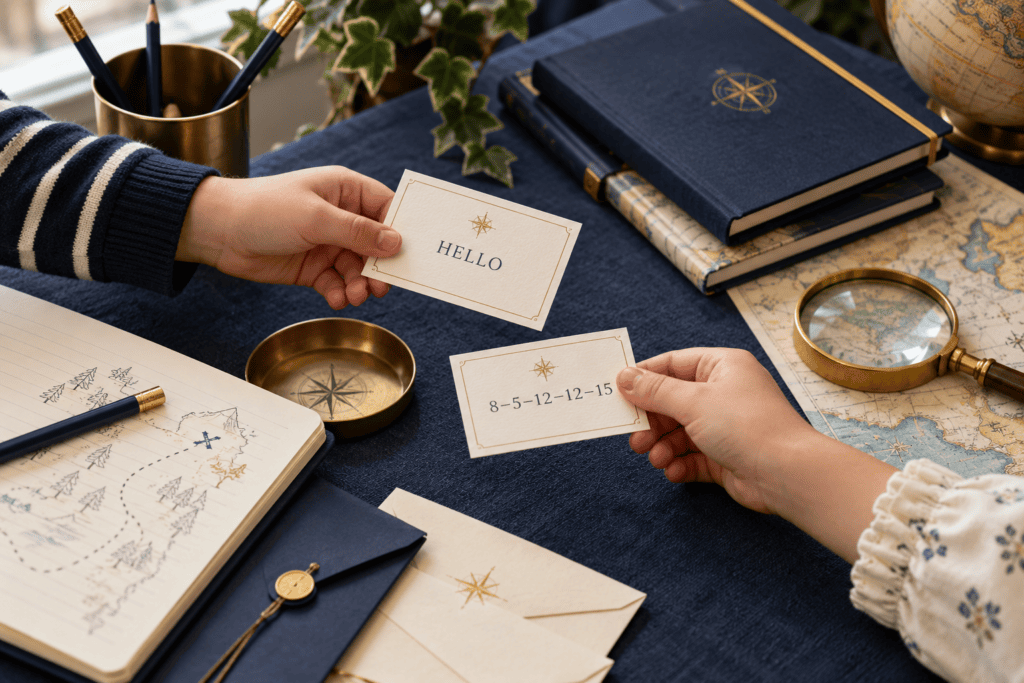
Pair children and give each person a role: one checks the key while the other writes the decoded letters. Swap roles for the next mission. Finish by asking each pair to explain the rule they used. You can also turn the messages into spy party games by giving every team the same code and letting them solve cooperatively.
Build a Screen-Free Activity Routine
A short code makes a useful starting point when a child wants something specific to do. Keep paper and pencils within reach, and let them choose whether to decode a message or write one for you. For a wider menu, explore 12 Screen-Free Activities for Kids Ages 8–12. You can also combine one mission with an idea from 5 After-School Activities for Kids Ages 8–12.
If the mystery theme is the part they enjoy most, try the setup ideas in Printable Detective Game for Kids: An Easy At-Home Mystery. These related activities give families different ways to extend the same interest without repeating one puzzle every day.
Ready for a Story-Based Spy Adventure?
For families looking for printable puzzle games for kids with a continuing story, Spy Academy: The Master Key is a printable spy game for kids ages 8–12. It follows an Academy lockdown after an intruder steals the Master Key, with codes, riddles, and clues across 15 spy-themed puzzles. The product is a downloadable PDF for solo play or a team.
Start with the free mini-missions above to see which style your child enjoys. If they want a full story to solve next, explore Spy Academy and choose a day for your next paper-and-pencil adventure.