
A memory tray game for kids turns a handful of everyday objects into a small challenge: look closely, cover the tray, and work out what has changed. You can play at the kitchen table with items you already have. There is no printing required for this homemade activity, and you can adjust each round as you go.
This version is designed for children ages 8–12. Start with eight objects and give everyone time to observe before you remove one. Plan around 10–15 minutes for a few rounds, although you can stop sooner or keep playing if your group enjoys it. The aim is to notice details and explain ideas together.
What you need for a memory tray game for kids
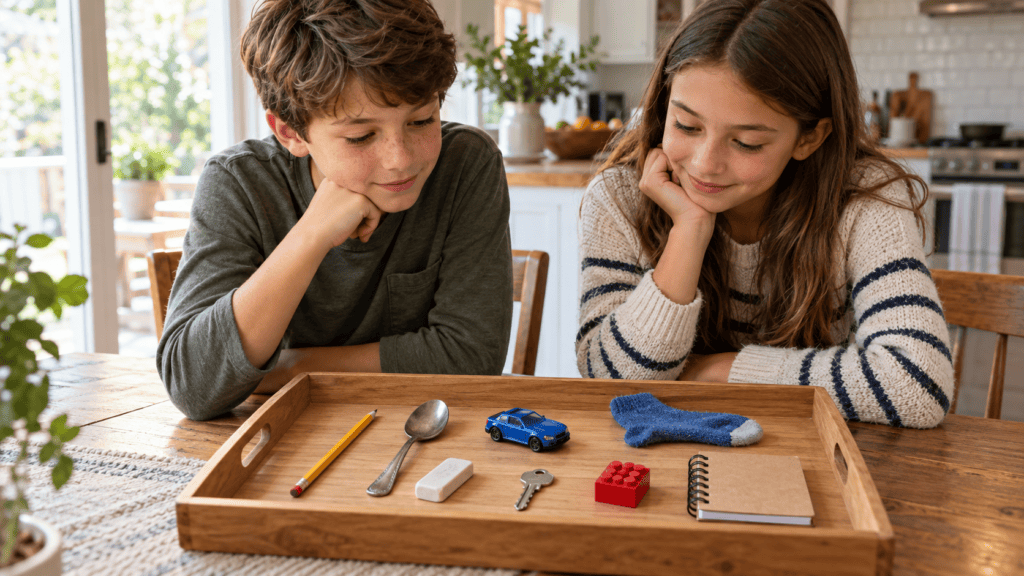
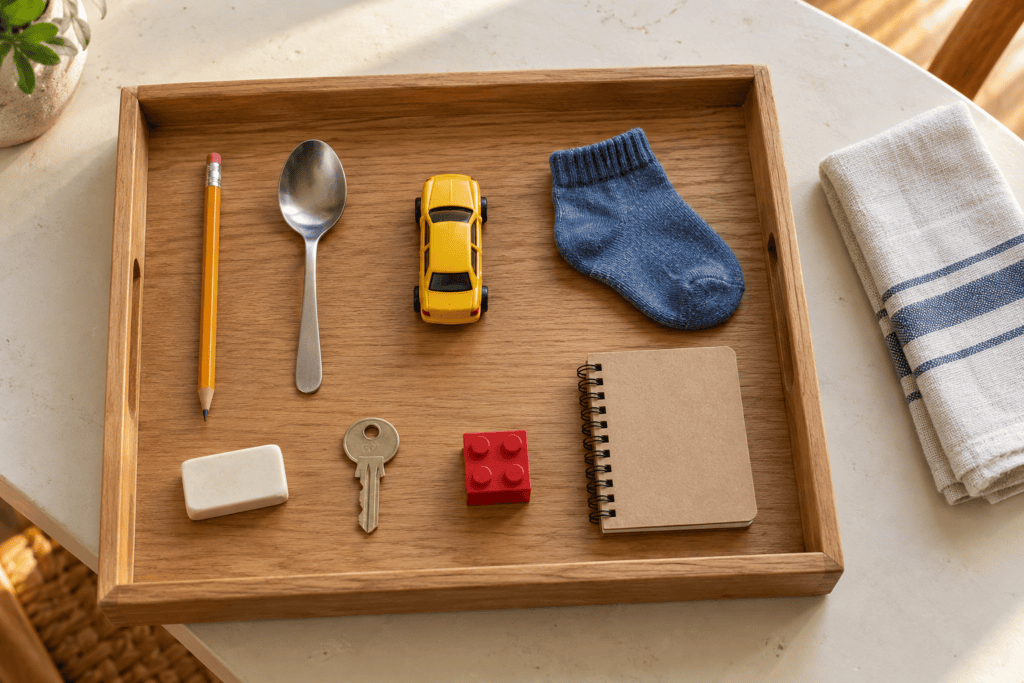
Gather a tray, a tea towel large enough to cover it, and eight distinct objects. Try a pencil, spoon, toy car, clean sock, eraser, key, building block, and small notebook. Choose familiar items that are easy to distinguish. Keep the objects on the table throughout the activity.
A tray is useful because you can move the whole collection without changing the arrangement. However, you can also mark out a space on a table and cover the objects there. Paper and pencils are optional if children prefer to write their answers privately before discussing them.
How to play the first round
Look carefully at the objects
Place all eight objects on the tray with space between them. Invite children to look for about 30 seconds, then ask whether they want more time. Tell them in advance that one object will disappear. They can name the items aloud or quietly look at the collection.
Cover the tray and remove one item
Cover everything with the towel. Ask players to turn away while you remove one object and put it out of sight. Leave the remaining objects in their original positions for the first round. Then lift the towel so everyone can examine the tray again.
Find what is missing
Ask each player to decide which item has disappeared. Give everyone a moment to think before sharing answers. In a cooperative round, children can compare what they remember and agree on one answer. Reveal the missing object, then let a child prepare the next round.
If nobody remembers, reveal a useful clue such as “It was something you can write with.” The clue should guide the group toward the missing item. There is no need to count wrong guesses or rush the answer. Once you reveal it, reset the collection and try again.
Three ways to change the challenge
Swap positions instead of removing an object
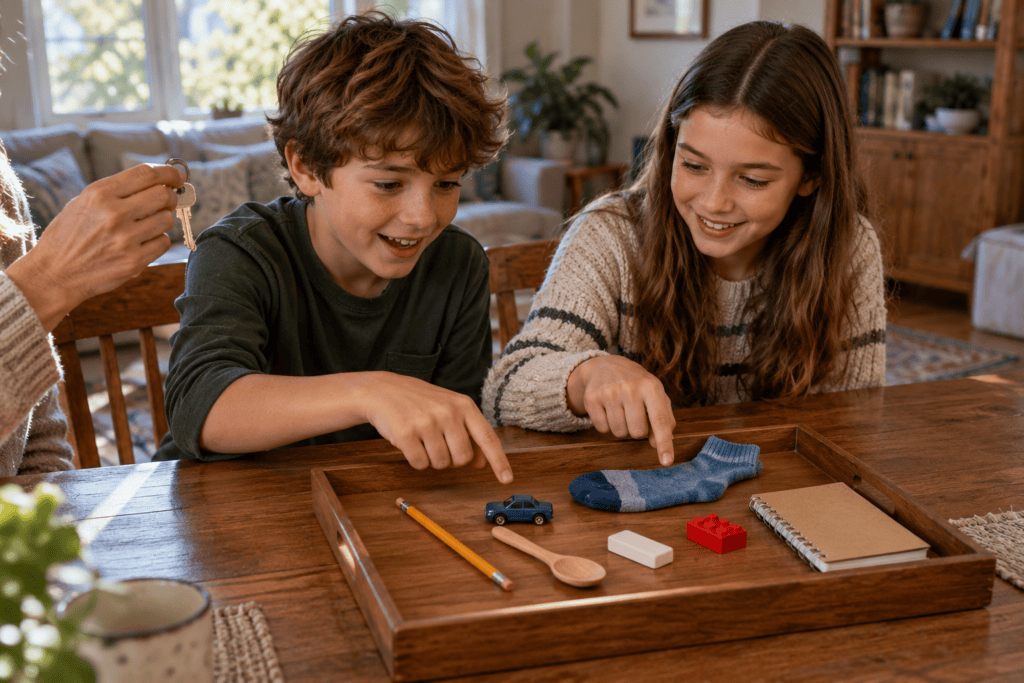
Keep all eight items, but move two of them while the tray is covered. Ask which two changed places. Start with objects far apart so the change is easy to spot. For a harder round, move neighboring items. Tell players which kind of change to expect before they observe.
Replace one object with a new one
After children study the tray, replace the spoon with a fork or the blue sock with a different clean sock. Players need to identify both the item that disappeared and the item that arrived. Keep the new object clearly different at first, then try a subtler swap if they want a challenge.
Remember a detail as well as an item
Invite children to notice one detail about each object, such as the color of the car or the shape of the key. After covering the tray, ask a question about a detail. Avoid details that were too small to see from where players sat. Uncover the objects so everyone can check the answer.
Adjust the game for your group
If eight items feel overwhelming, start with five and allow a longer look. Let children describe the objects together before you cover them. If the activity feels easy, add one or two items. Change only one rule at a time so players know what they are looking for.
For siblings or a small group, rotate the roles of observer, tray keeper, and answer checker. You can also give everyone the same job and solve each round together. In a classroom, use a tray for each small group and ask children to take turns preparing the changes.
After a round, ask “What helped you remember?” One child may picture the layout; another may remember a short list. Let them try a new approach next time. Treat these as strategies to explore rather than a test of who has the best memory.
Continue with a printable spy adventure
This memory tray game is a homemade activity, separate from our downloadable adventures. If children want to follow a longer story with coded messages and clues, explore Spy Academy The Master Key. Designed for ages 8–12, it asks young agents to investigate a security breach and recover an override code. The PDF includes setup instructions, an answer sheet, a score sheet, and a Spy Academy certificate. No cutting, gluing, or assembly is needed.
Explore Spy Academy The Master Key
You can also browse the other Printed Adventures games to choose a story that fits your child’s interests. Keep the tray game for a short break and save a complete printable adventure for a time when children want a longer puzzle session.
Browse Printed Adventures games
Keep a tray ready for the next quiet afternoon
A memory tray game for kids is easy to repeat because a small change creates another round. Start with a few familiar objects, let children choose the pace, and invite them to run the game themselves. Which object would your child notice missing first? Share your idea in the comments.