
A Halloween mystery bag game gives curious kids a small case to solve with their hands. Hide familiar objects in opaque bags, ask players to describe what they feel, and let them explain their guesses before the reveal. It is a simple screen-free activity for a family afternoon, a classroom station, or the quieter part of a Halloween gathering.
For ages 8–12, the interesting part is the evidence. A quick guess becomes a stronger challenge when children must name two details and explain why those details fit. Here is a complete version you can set up with everyday objects, plus ways to adjust it for different players.
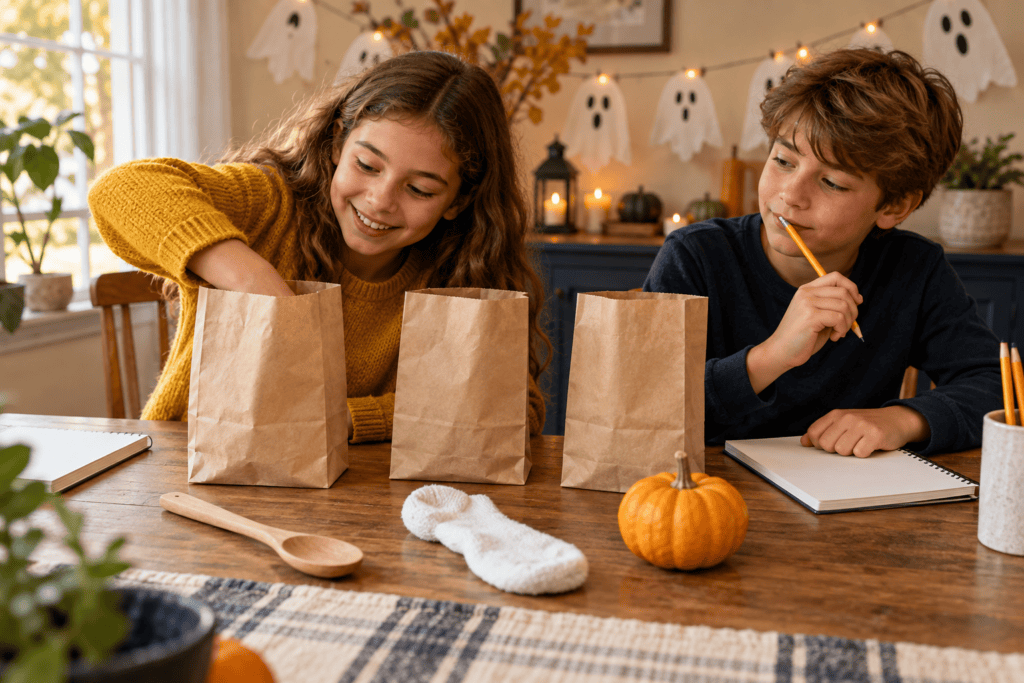
What you need for a Halloween mystery bag game
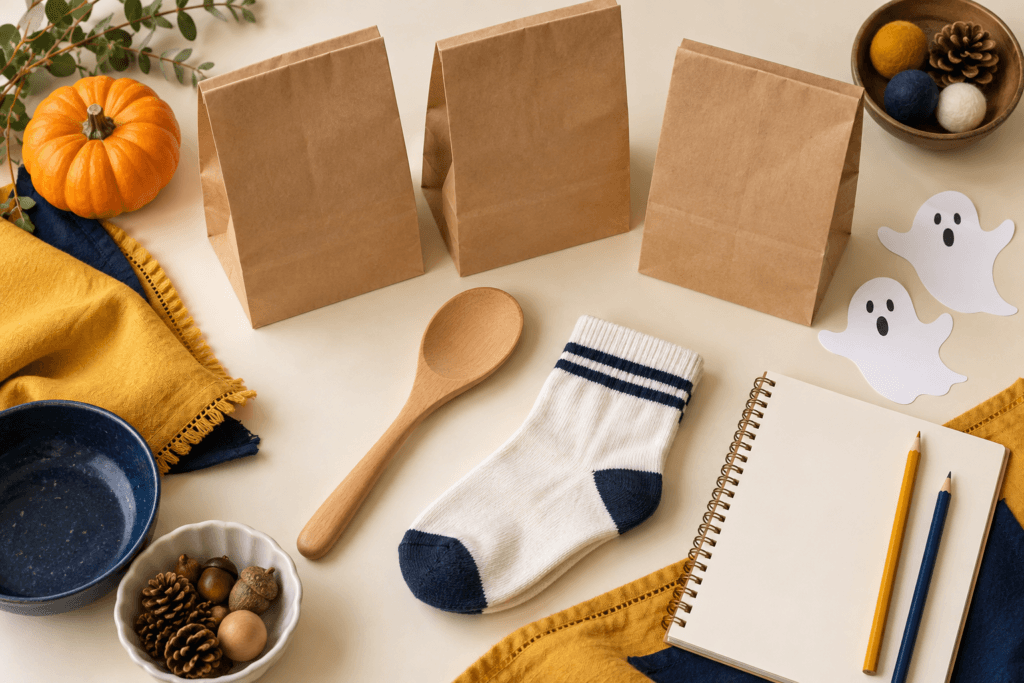
Gather three opaque paper or fabric bags, a pencil for each player, and a sheet of paper. Choose one clean object for each bag. A wooden spoon, a cotton sock, and a small smooth pumpkin make a useful starting set because their shapes and textures differ. Check that each object fits through the opening and that the bag hides it from view.
Keep the objects dry and comfortable to touch. Choose items without sharp edges or loose pieces, and tell children what kind of activity to expect. Anyone who prefers not to reach inside can hear a partner’s descriptions and make a guess instead.
How to play the mystery bag game
Set up one object in each bag
Put the spoon in bag A, the sock in bag B, and the pumpkin in bag C while the players look away. Write the letters on the bags. Leave enough room for a hand to explore each object. You can add a paper ghost nearby for atmosphere, but decorations are optional.
Collect clues before naming the object
Invite one child to feel inside a bag without looking. Ask for two observations first. Is the object smooth or textured? Does it bend? Is it long, round, hollow, or flat? Give everyone time to listen before they suggest an answer. The point is to notice details rather than race to shout a familiar word.
Record a guess and a reason
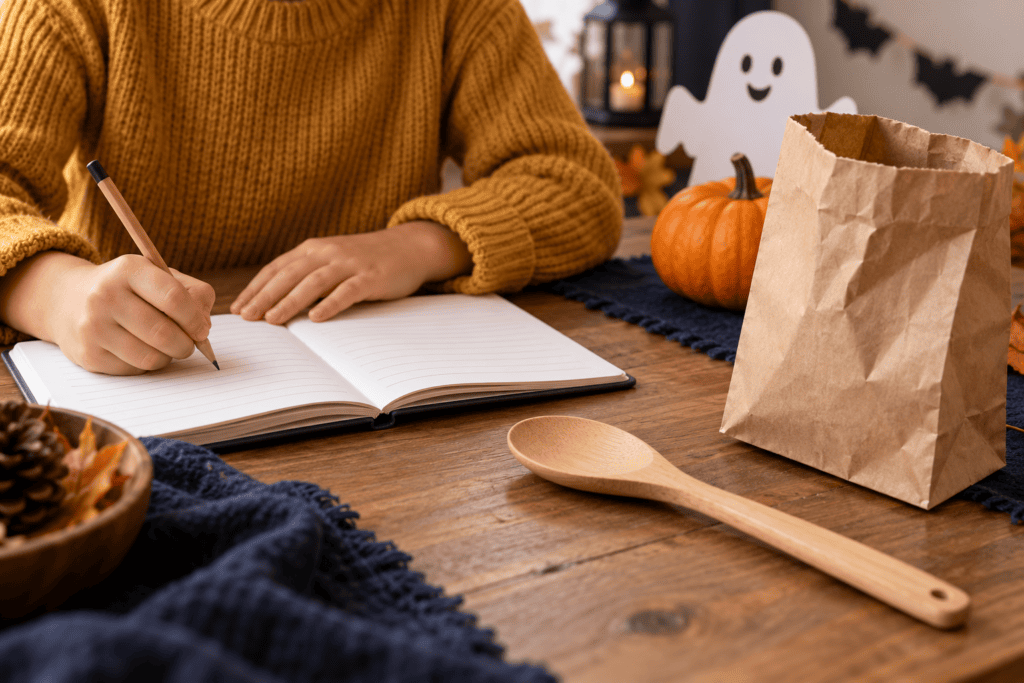
On the paper, write four headings: Bag, What I noticed, My guess, and Why it fits. A child might write: “A — long handle and a curved end — wooden spoon — it feels like something used for stirring.” Younger players can draw the shape and explain their reasoning aloud.
Reveal and compare
Once everyone has guessed, show the object. Ask which clue helped most and whether anyone changed their mind. Then move to the next bag. If you want points, award one for naming the object and one for an accurate observation. Keep the explanation as valuable as the answer.
Ready to use clue examples
For the spoon, try: “I have a handle, but I do not open a door. I help you stir.” For the sock: “I am soft and bendy. I usually have a partner.” For the pumpkin: “I am rounded, with ridges and a stem. You often see me in October.” Give a hint only after players have shared what they noticed.
You can also name the bags after imaginary rooms: the ghost’s kitchen, the costume cupboard, and the pumpkin porch. The objects stay ordinary, while the little story gives the activity a Halloween mood. These are homemade examples, separate from the puzzles in our printable games.
Make it work for different ages and groups
An easier round
Show the three possible objects before hiding them, then ask children to match each bag to one item. This removes the need to think of every possible household object. Let players use a second touch or request one spoken clue.
A harder round
Add two possible answers with similar features, such as a clean mitten and a sock. Ask players to find a detail that rules one out. For example, a mitten has a separate thumb section. Encourage children to change a guess when new evidence appears.
A cooperative classroom version
In a small group, rotate three roles: explorer, note taker, and clue checker. The explorer describes the object, the note taker records the evidence, and the clue checker asks a useful question. Rotate roles at the next bag so everyone has a turn. An adult or nonplaying helper can reset the bags between groups.
Turn a short activity into a longer Halloween adventure
The Halloween mystery bag game is a hands-on warm-up that needs a little preparation from a grown-up. If your children want a longer story after the reveal, Ghost Hunters The Whispering Manor takes the mystery onto printed pages. Designed for ages 8–12, it includes a downloadable PDF, an answer sheet, and a Ghost Hunter certificate. There is no cutting, gluing, or assembling.
Explore Ghost Hunters The Whispering Manor
For more ideas on arranging a table-based mystery, read our Halloween puzzle night guide. Or, if your family prefers a neighborhood case to a haunted manor, explore Detective Club The Case of the Missing Dog.
Read the Halloween puzzle night guide
Explore Detective Club The Case of the Missing Dog
Start with three bags and let the children’s observations lead the game. Which everyday object would make the most surprising mystery in your house?