
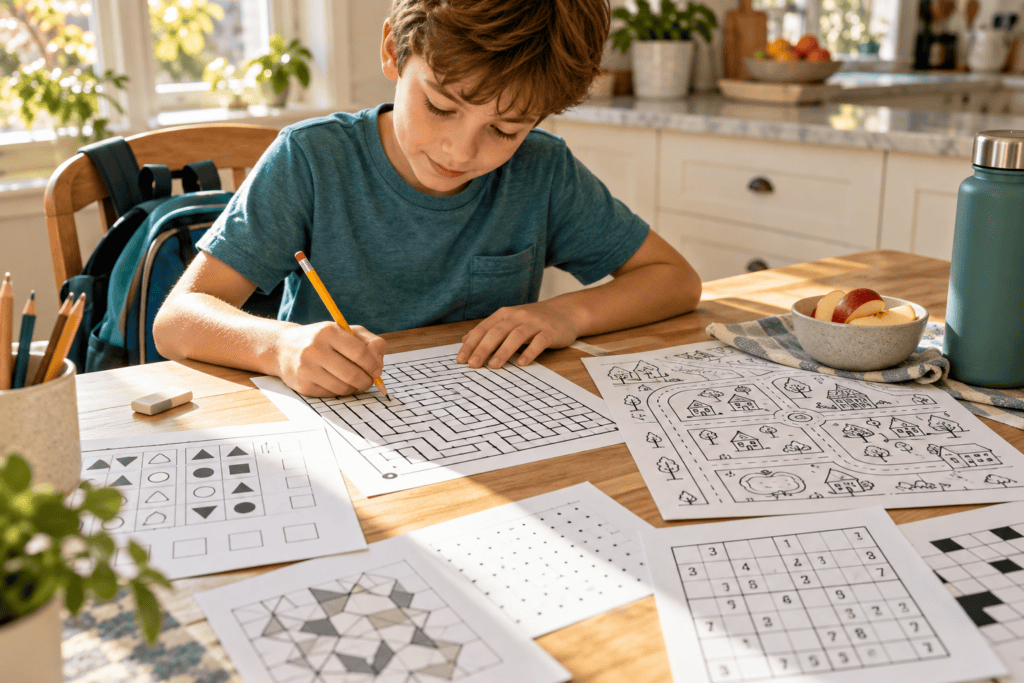
Looking for after-school activities for kids who keep asking, “What can I do now?” You do not need a packed timetable or a cupboard full of craft supplies. A pencil, a few sheets of paper and a choice of small challenges can give an ordinary afternoon somewhere interesting to go.
This guide focuses on flexible activities for ages 8–12. Some take only a few minutes; others can grow into a longer project. Start with the time and energy your child actually has, rather than trying to complete the whole list.
Make room for a pause first
Before offering an activity, leave room for a snack, a drink or a quiet moment. Ask whether your child feels like moving, making something or solving a puzzle. They can choose to rest, too.
If homework or a club is coming up soon, pick a short activity with an easy stopping point. On a free afternoon, let your child extend an idea or return to it later. The times below are suggestions, not targets.
1. Create a secret message on paper
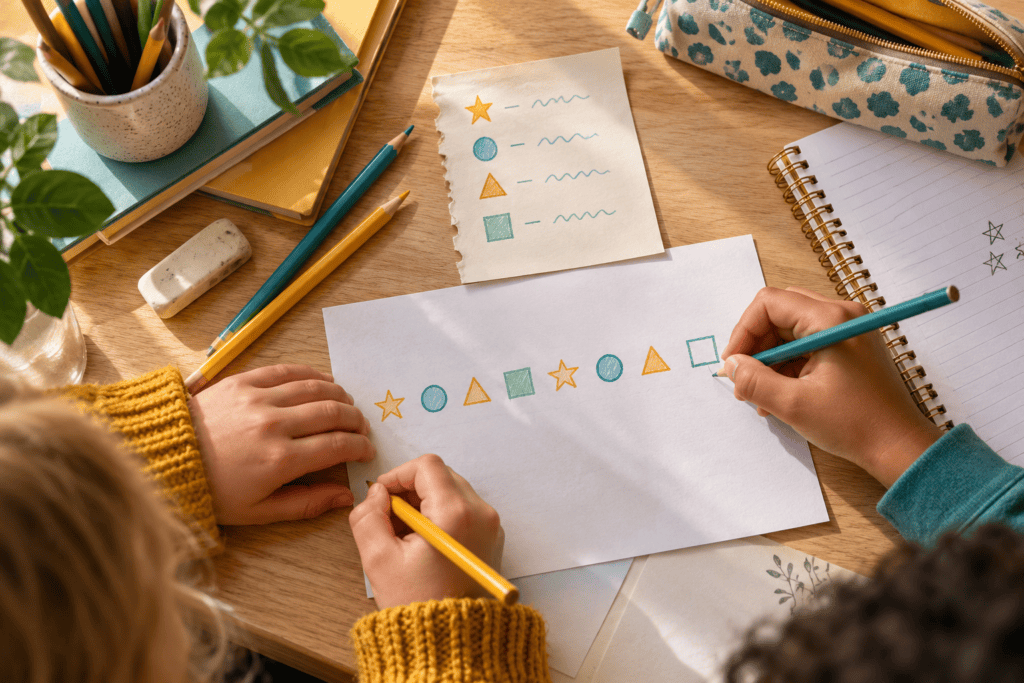
Draw four or five simple symbols and give each one a letter. A star could mean A, a circle could mean E and a triangle could mean T. Choose a short word using your selected letters, then write it in symbols with the key beside it.
Let your child decode your message before making one for you. For a larger alphabet, use A = 1, B = 2 and so on. For example, CAT becomes 3–1–20. Keep the first message short so the method is easy to understand.
Change the challenge to suit your child
A beginner can keep the key visible throughout. A confident puzzle fan can create a longer message or deliberately include a repeated word to give the reader a clue. Ask them to check that every symbol has one consistent meaning.
Allow about ten minutes, with extra time if your child wants to swap messages with a sibling. This is a homemade activity; you do not need a printable game to try it.
2. Draw a tiny town and invent a route
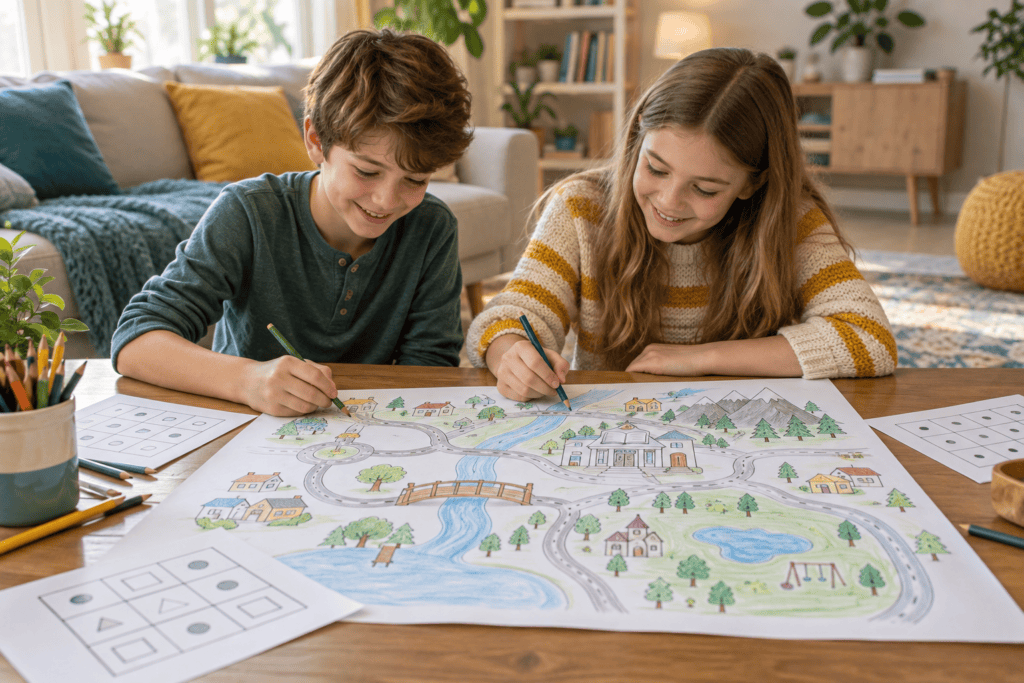
On a sheet of paper, draw a park, a library, a house and a bridge. Connect them with roads. Then invent a route challenge: “Visit the library and park before going home, but do not cross the bridge.”
Your child can trace a route with a pencil or move a small counter along the roads. Next, swap roles and let them design a town for you. They can add a closed road, an extra bridge or a place that must be visited first.
Test the map before sharing it
Ask your child to check whether their challenge has a solution. If a route is impossible, changing the map is part of the activity. There is no need to make every first idea work perfectly.
This is one of the after-school activities for kids that can stay small or become a whole afternoon project. Start with fifteen minutes and keep the map if they want to add to it another day.
3. Make a puzzle for someone else
Invite your child to choose one simple format: a maze, a repeating pattern or a spot-the-difference drawing. For a pattern, they could draw circle, square, square, circle, square, square and ask what comes next.
For a maze, mark a start and finish, then draw a route between them before adding dead ends. For spot the difference, make two small drawings and change three details in the second. Simple pictures are enough; this is about the challenge, not perfect artwork.
When the puzzle is ready, let another person test it. Ask, “Were the instructions clear?” and “Was there an answer that worked?” The creator can adjust confusing details and keep a separate answer drawing.
A folder of homemade puzzles can become a small family puzzle book. Add a new page whenever your child feels like making one, without turning it into a daily obligation.
4. Take a noticing walk
If your child wants to move, try a short walk with a small observation challenge. Look for three different leaf shapes, two repeating patterns and something that makes an interesting sound. Adapt the route to your surroundings and accompany your child as needed.
Back at home, invite them to sketch one thing they noticed. They might turn a fence pattern into a drawing puzzle or use a street corner as inspiration for their tiny town.
If going outside is impractical, use the same idea indoors: find three textures, two shapes and one object you have never drawn before. Keep it playful and skip the drawing if the walk itself was enough.
5. Save a printable mystery for a longer afternoon
Some days leave enough room for a complete story. Detective Club: The Case of the Missing Dog is a printable mystery for ages 8–12 in which children follow evidence to investigate Buddy’s disappearance.
The download includes the adventure pages, setup instructions, an answer sheet, a score sheet and a Detective Club certificate. The game requires no cutting, gluing or assembly. Allow about an hour rather than treating the full adventure as a quick ten-minute break.
If secret missions are more appealing, Spy Academy: The Master Key offers a different story built around decoding clues and investigating a security breach. Let your child choose the setting before you print.
These paid adventures are separate from the homemade activities above. On a busy school day, choose a short paper challenge; save a complete mystery for a day when there is time to enjoy it.
Choose after-school activities for kids by time and mood
For a short gap before homework, try one coded word or a quick pattern puzzle. With fifteen or twenty minutes, draw a town or design a maze. When there is more time and your child wants a longer story, consider a printable adventure.
Offer two options instead of a long menu: “Would you like to make a map or decode a message?” Leave the pencils and paper within reach so starting does not become another task for you.
For more ways to share play around a busy schedule, read our ideas for quality family time with printable games.
After-school activities for kids can be simple, flexible and easy to return to. Try one idea today, follow your child’s interest and keep the unfinished pages for another afternoon. If they are ready for a bigger investigation, take a look inside Detective Club.