
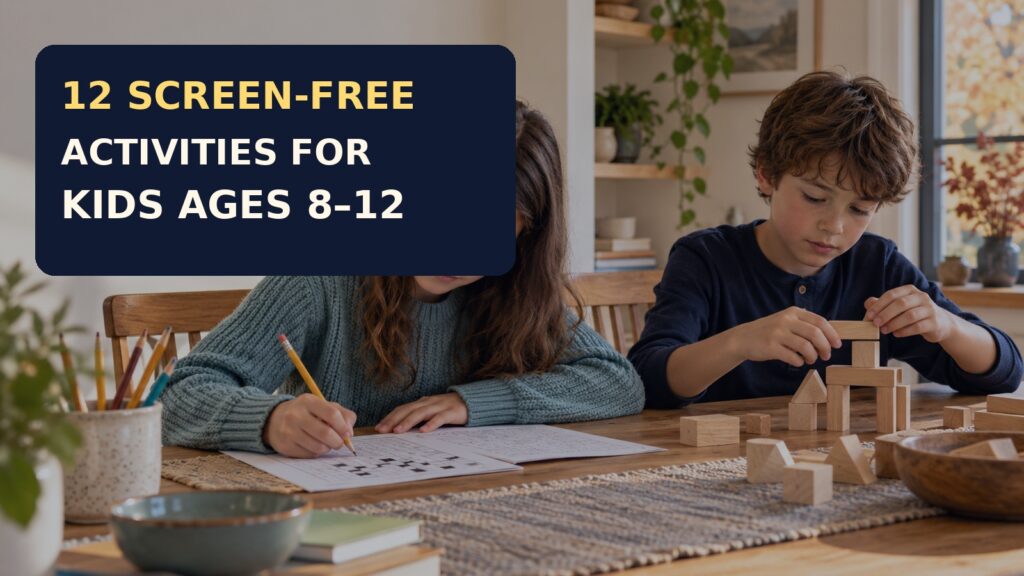
Finding screen-free activities for kids ages 8–12 can be surprisingly difficult. Children in this age group have moved beyond many preschool crafts, but they may still need a clear starting point before they can settle into independent play. If you simply say, “Find something to do,” you may get an eye roll—or another request for a device.
A shorter menu often works better than a giant list. Offer three paths: Create, Move, or Solve. Your child chooses the type of activity first, then picks one idea from that category. This keeps the decision manageable while still giving them control.
The activities below use common supplies, require little preparation, and suit ordinary afternoons, weekends, family time, or classroom breaks.
Creative Screen-Free Activities for Kids Ages 8–12
Creative activities work best when the prompt is specific enough to spark an idea but open enough for children to make it their own.
1. Make a four-panel comic
Fold a sheet of paper into four sections. Give your child a simple opening problem, such as “The school pet has disappeared” or “A mysterious key arrives in the mail.” They decide what happens next and tell the story in four panels.
If starting feels hard, offer three possible characters and let them choose one. The goal is not perfect drawing. It is turning an idea into a beginning, middle, and ending.
2. Design a new room for an imaginary place
Ask your child to design one room inside a wizard school, spy academy, haunted manor, space station, or underwater hotel. They can draw a floor plan and label the important objects.
Add one rule: the room must contain a secret, a useful tool, and one obstacle. That small constraint turns a drawing activity into a storytelling challenge.
3. Build with a limitation
Put out blocks, recycled boxes, paper cups, or craft sticks. Instead of saying “Build anything,” give a focused challenge:
- Make a bridge that can hold a book.
- Build the tallest tower using only 20 pieces.
- Create a shelter for a small toy.
A clear limitation encourages experimentation. If the first design fails, ask what they would change rather than showing them how to fix it.
4. Create a family quiz
Let your child write ten questions about a favorite topic, a book, animals, geography, or family memories. They can host the quiz later and keep score.
This activity quietly combines research, writing, and public speaking. It also gives children the satisfying role of being the expert.
Screen-Free Activities That Get Kids Moving
Not every off-screen activity needs to happen at a table. Short physical challenges can reset the mood after school or break up a long indoor afternoon.
5. Build a mini challenge course
Choose three safe household actions: walk heel-to-toe along a line, carry a soft object across the room without dropping it, and toss rolled socks into a basket. Let your child arrange the order and decide how to score the course.
Keep it compact. A ten-minute challenge is easier to begin than an activity that sounds like an entire afternoon.
6. Take a mission walk
Give an ordinary walk a purpose. Ask your child to find five different textures, three signs of the season, something symmetrical, and an object that could inspire a mystery story.
No camera is necessary. When you return, compare what everyone noticed.
7. Try the one-minute family tournament
Choose three quick events that use simple objects: stacking cups, balancing a pencil, moving cotton balls with a spoon, or landing paper balls in a container. Give each player one minute per event.
Children can create the score sheet, explain the rules, and invent a final tie-breaker. The planning is part of the fun.
8. Make movement cards
Write actions on small pieces of paper: hop ten times, move like a robot, balance for 20 seconds, or invent a silent dance. Mix the cards and take turns drawing one.
For older children, add “creator cards” that ask them to invent the next challenge for everyone else.
Screen-Free Activities for Kids Who Love to Solve
Some children switch off when they hear “educational,” yet become absorbed when there is a mystery, code, or clear problem to solve.
9. Write and crack a secret code
Create a simple symbol alphabet or shift each letter forward by one place. Write a short message for another player to decode. Then swap roles.
Start with one sentence. Once the system works, children can write clues that lead around the room or create a coded invitation.
10. Make a household logic mystery
Choose three toys or objects and invent a tiny mystery: one object has been moved, and three characters each offer a clue. The answer should be discoverable by comparing the statements.
Children can test the mystery on an adult. If more than one answer seems possible, revise a clue until the puzzle works.
11. Try a puzzle sampler
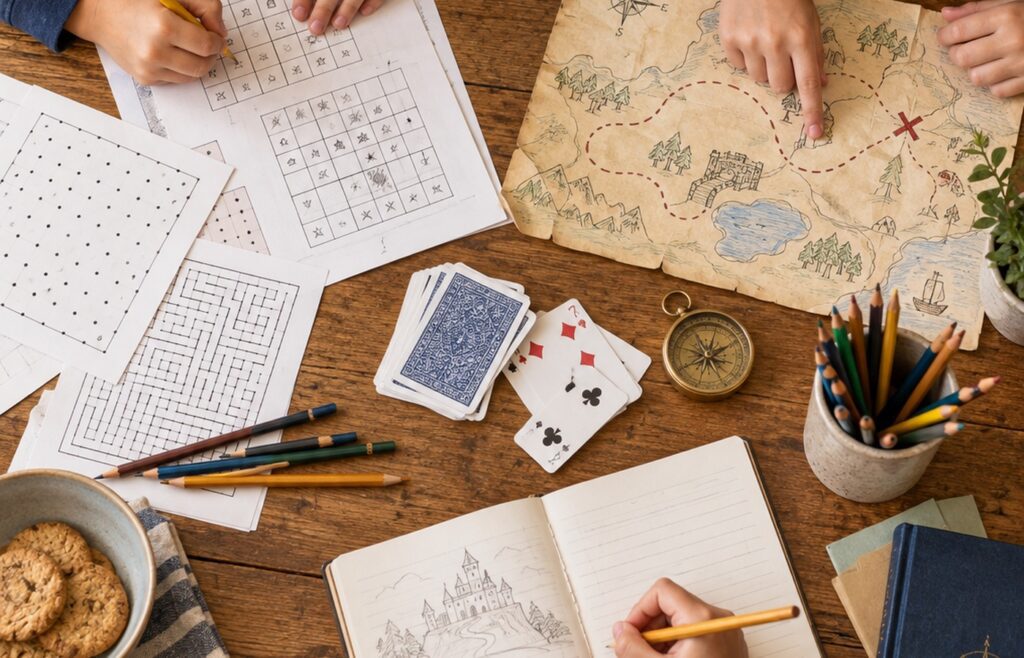
Set out three different puzzle types: a maze, a word code, and a visual pattern. Let your child choose the first one rather than completing them in a fixed order.
If you want a ready starting point, the Printed Adventures sample page includes mini-puzzles that families can try before choosing a longer adventure.
12. Play a story-based printable adventure
For a longer activity, use a printable mystery or escape-style game that connects each puzzle to one continuing story. Children can work alone or compare ideas as a team, depending on the game and the group.
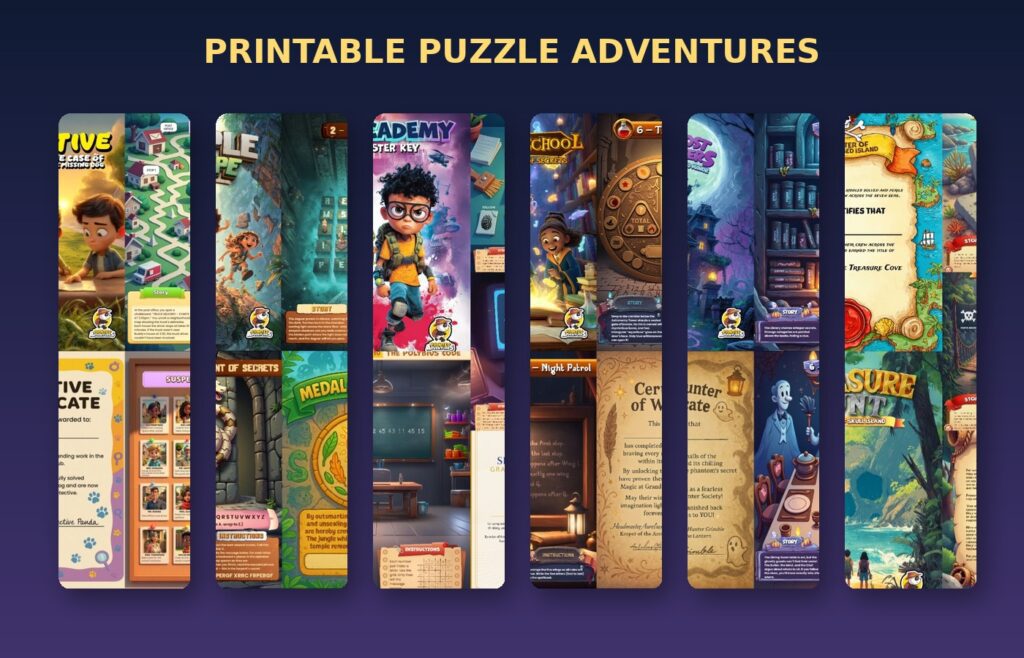
Printed Adventures offers themed mysteries for ages 8–12, including detective, spy, pirate, wizard, ghost, and temple stories. The games are downloaded as PDFs and are designed to be printed and played at the table. Families looking for several themes can explore the Adventure Bundle.
How to Make Screen-Free Time Easier to Start
The transition away from a device can be harder than the activity itself. These small changes can reduce friction.
Offer choices before boredom peaks
Mention the next activity while the current screen session still has a clear ending. “When this episode is over, do you want to create, move, or solve?” feels more concrete than a sudden demand to stop.
Prepare a small activity shelf
Keep pencils, plain paper, cards, tape, and a few printed puzzles in one reachable place. Children are more likely to begin when they do not need to search for supplies or ask an adult to set everything up.
Do not oversell it
You do not need to announce the “most amazing activity ever.” Give a simple invitation and enough space for the child to take ownership. A calm start often works better than a big buildup.
Let interests guide the format
A child who loves stories may prefer comics or mysteries. A builder may choose a design challenge. An energetic child may need movement before sitting down with a puzzle. Screen-free time does not have to look the same for every child.
For more ways to support thoughtful play, read How to Encourage Problem-Solving Skills at Home and Why Story-Based Puzzles Improve Kids’ Problem-Solving Skills.
Keep the Menu Simple
The most useful screen-free activities for kids ages 8–12 are not necessarily the most elaborate. They are the activities a child can understand, choose, and begin.
Start with three words: Create, Move, or Solve. Offer one or two ideas under the chosen category, then let the activity grow from there. You are not trying to fill every minute. You are giving your child a manageable first step toward imagination, movement, or focused problem-solving.