
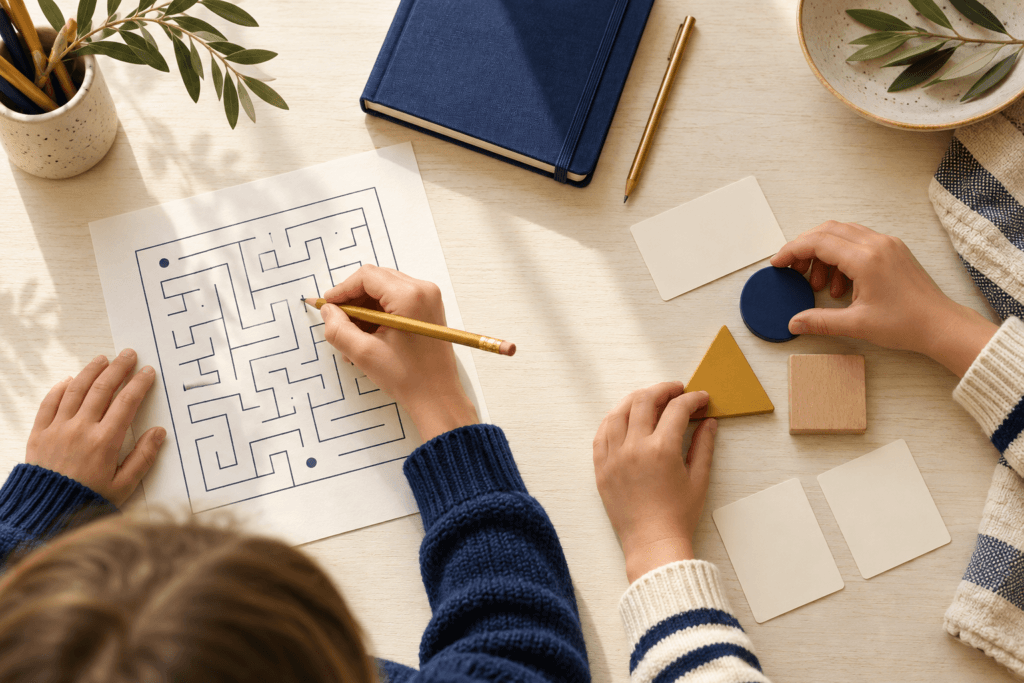
Puzzle games help kids practice thinking skills by asking them to compare clues, plan a route, test an idea, and explain their choices. These problem solving activities for kids can begin with a small question: which clue fits, what comes next, or how could we try a different route? For children ages 8–12, a paper puzzle or a simple tabletop game offers a reason to look carefully, explain an idea, and try again. You can make that practice part of an ordinary afternoon without turning play into another lesson.
Here are three original activities to try at home or in the classroom, plus ways to support attention, pencil control, and cooperation. They are standalone ideas, separate from the puzzles inside Printed Adventures games. Choose a challenge that suits your child’s current skills and interests, rather than expecting every child of the same age to play in the same way.
How puzzle games help kids practice thinking skills
In a logic game, children compare information and check whether a possible answer follows the rules. When they explain a choice, you can hear their reasoning. A wrong answer can become useful information: it shows which rule or clue needs another look.
Harvard’s Center on the Developing Child offers an activity guide for ages 7–12 that includes strategy games and brain teasers as opportunities to practice planning, working memory, and flexible thinking. This supports offering varied, appropriately challenging play. It does not establish that a particular commercial puzzle game improves school grades or intelligence. Read the age-specific activity guide.
For parents, the practical question is simple: what does this activity ask my child to do? A matching challenge asks for comparison. A mystery asks for evidence. A route puzzle asks for planning. These are opportunities for practice, with no promised developmental result.
Three problem solving activities for kids to try today
1 Find the hidden shape
Draw three large shapes on paper: a red circle, a blue square, and a green triangle. Say, “My shape is not red. It has four equal sides.” Ask your child to point to the shape that fits both clues and explain why.
The answer is the blue square. The red circle fails the color clue, and the green triangle fails the sides clue. This is a small deduction game: children use information to rule out choices instead of guessing.
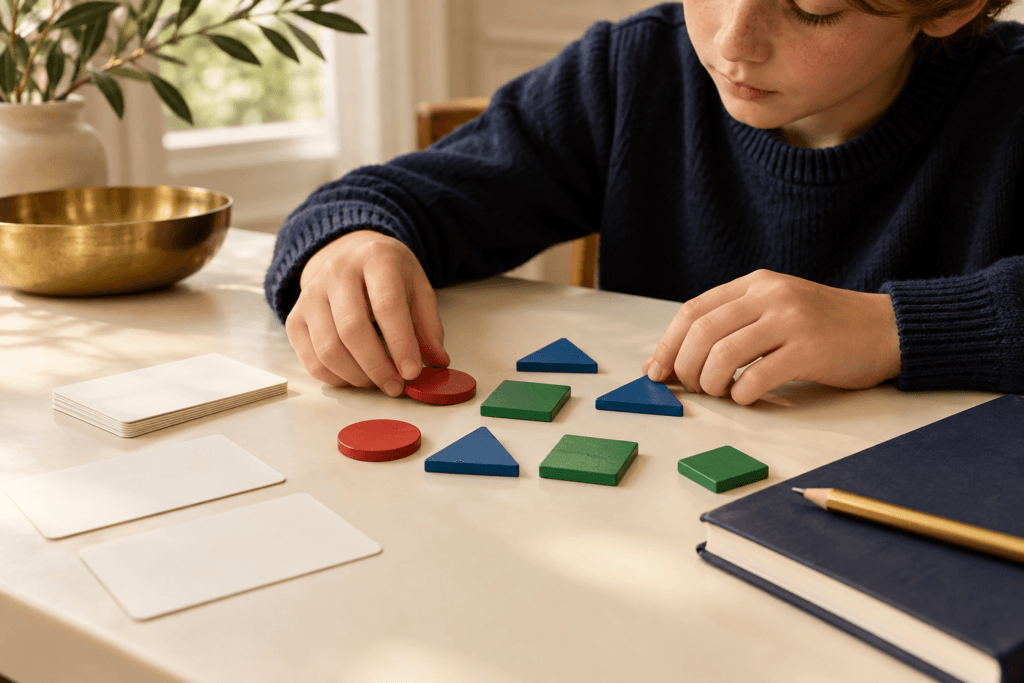
To make it easier, read one clue at a time and cross out each rejected option. For a harder version, add a yellow square and a blue triangle, then use the clues “It is blue” and “It has four sides.” The blue square remains the only answer. Let your child create the next round and check that their clues identify exactly one shape.
2 Follow a changing pattern
Write the numbers 2, 4, 7, 11, followed by a blank. Ask, “If the rule is to add one more than we added last time, what comes next?” Invite children to write the jumps above the numbers.
The jumps are +2, +3, and +4. The next jump is +5, so the answer is 16. Giving the rule matters: an unfinished number sequence can have more than one possible continuation. Here, children have a clear rule to apply and an answer they can check.
For an easier round, use 3, 6, 9, 12 and say “Add three each time.” The next number is 15. For a harder round, ask your child to design a sequence, state its rule, and make an answer key. Explaining the rule is part of the activity, not an optional extra.
3 Plan a route before drawing
Draw a start dot and a finish dot on plain paper. Add three large circles between them as obstacles. The challenge is to draw a route between the dots without touching a circle or lifting the pencil.
Before drawing, ask your child to describe a possible route or trace it in the air. Then let them test it on the page. There can be many successful answers; check the route against the stated rules rather than comparing it with one model solution.
This combines planning with small, controlled hand movements. Tracing, drawing, and writing use fine motor control, while reading clues aloud does not provide the same hand practice. Keep the obstacles well spaced. If pencil use is uncomfortable, your child can point out a route while someone else draws it. They can still take part in the thinking challenge.

Attention and memory without pressure
Start with one short instruction and leave the rules visible. Children can refer back to a clue card or written rule while they work. Looking again is a useful strategy, not a failure to remember.
When they are comfortable, add a second instruction or ask them to summarize the goal before starting. Keep changes small. An activity that feels manageable invites more thoughtful play than one that requires repeated adult rescue.
If you want to explore more screen-free activities for kids, read why Printed Adventures began creating printable adventures for families. Rotate quiet paper play with movement, outdoor time, building, and other activities your child enjoys.
Cooperation and patience during logic games for kids
For two players, let one read the clue while the other tests an answer. Switch roles after each round. In a small classroom group, give everyone a chance to describe an idea before choosing a solution together.
Try asking “Which clue supports that?” or “What could we check next?” These questions keep the focus on the process. When children disagree, return to the rules and compare both ideas. You do not need to praise speed or make a leaderboard.
If frustration rises, offer one useful hint or pause. A break does not spoil the activity. You can return later with fewer choices, wider drawing spaces, or a simpler rule.
Choosing printable puzzle games for kids ages 8–12
Look for readable instructions, a theme your child likes, and solutions an adult can use when help is needed. A story can give children a reason to continue from one challenge to another.
Detective Club The Case of the Missing Dog is a printable detective game for kids ages 8–12. Its neighborhood mystery uses clues and evidence to guide the investigation. It is an instant PDF download with instructions and an answer sheet, designed to play without cutting, gluing, or assembling.
Choose it when your child wants a longer story after trying a short activity. The game is an entertainment product with puzzle practice, rather than a tested developmental intervention. The original activities in this article do not reproduce its pages or puzzles.
A simple way to finish the activity
Ask your child to show one choice they changed, one clue they used, or one rule they explained. Listen to the answer without scoring it. That gives you a useful glimpse of how they approached the task.
Save these problem solving activities for kids for your next quiet afternoon. Start with one, adjust the challenge, and let your child help choose what to try next.