
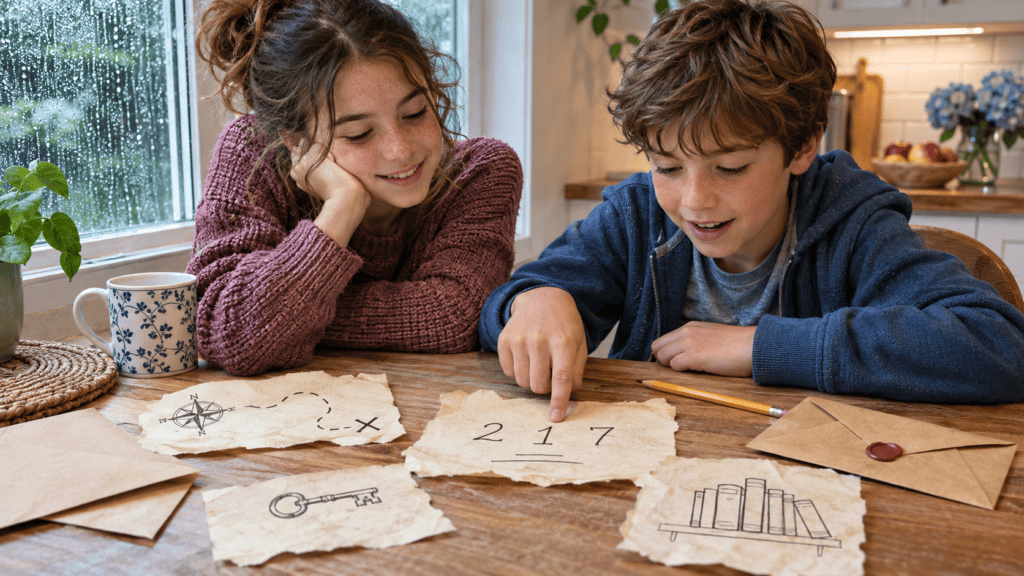
Rain has cancelled your outdoor plans, and the familiar question arrives: “What can we do?” A small paper mystery gives that afternoon a direction. Children have something to discover, a reason to compare ideas, and a finish line they can reach at the kitchen table.
These rainy day mystery activities for kids use ordinary paper and pencils. The original mini-case below is a DIY activity, separate from the games sold by Printed Adventures. You can copy the clues by hand or print this section before play.
Set up the missing postcard mystery
The story is simple: a postcard has disappeared from the family noticeboard. A friendly messenger has put it somewhere safe and left three clues. Your investigators must discover the hiding place and its secret delivery code.
You need three envelopes, paper, pencils, and a postcard or a small note. Use a safe, reachable bookshelf as the final location. Put the postcard there before starting. Keep the clues on the table; children do not need to search cupboards or climb furniture.
Write the following opening message: “The postcard is safe. Find its location, work out the delivery code, and explain how you know.” Label the envelopes LOCATION, ORDER and CODE. Let the children open them in that order.
Clue 1: Read the beginnings
Copy these three lines onto the LOCATION card, keeping the line breaks:
Books stand together here. Every shelf holds a different story. Look where the books live.
Ask: “Which place do all three sentences describe?” The answer is a bookshelf. This opening clue builds confidence before the harder deductions. The heading is a prompt to begin the investigation; this is a descriptive riddle, not an acrostic.
For a harder version, replace the three lines with: “I have shelves, but I am not a shop. I hold stories, but I never speak.” Keep the answer unchanged so the rest of the case still works.
Clue 2: Put the deliveries in order
On the ORDER card, write: “Three deliveries arrived: a blue envelope, a green envelope and a red envelope. Green arrived before red. Blue arrived after red. What was the order?”
Give children three small scraps in those colours, or write the colour names on plain paper. Moving them around lets children test the clues without holding every detail in memory. Ask them to explain both statements before settling on an answer.
Clue 3: Build the delivery code
On the CODE card, write: “Green = 2. Red = 1. Blue = 7. Read the numbers in delivery order.”
Leave a line for the final answer: “Location: ______. Code: ______.” There is no need for a real lock. An adult can act as the delivery desk and check the investigators’ explanation before handing over the postcard.
Solutions and gentle hints
The location is the bookshelf. The delivery order is green, red, blue, because green comes before red and blue comes after red. The code is therefore 217.
If children get stuck, offer one question at a time. For the location, ask what object all three sentences have in common. For the order, ask which colour must sit in the middle. For the code, ask whether the numbers should follow the printed list or the order they just solved.
Avoid supplying the whole answer immediately. A small prompt gives the child another chance to make the connection. If the activity stops being enjoyable, solve one step together and move on.
Adapt the case for your group
For one child, let them talk through the evidence with you. For siblings, give each person a chance to explain one clue. A confident reader can read the story aloud, while another investigator moves the colour cards.
In a classroom or homeschool group, prepare one set per table. Keep the postcard at each table rather than sending everyone to the same bookshelf. Ask each group to submit both the code and a sentence explaining the order. This keeps the activity manageable in a shared room.
You can also change the story without rebuilding the puzzle. The postcard might be a museum invitation, a message from a space station, or a letter from a friendly dragon. Keep the logical statements unchanged if you want the same verified solution.
Make another rainy afternoon easier
Store the envelopes and answer sheet in a folder. Next time, change the colour-to-number key so the children cannot simply remember 217. Check your new code against green, red, blue before playing.
For a longer story-led activity, explore the printable adventures . The site offers downloadable games that you print at home, with codes, clues and themed stories. If you want several themes to choose from, see the adventure bundle.
Your rainy-day plan can stay small: one table, a few clues, and a mystery with an ending. Try the postcard case first, then invite your investigators to write a new clue for you.