
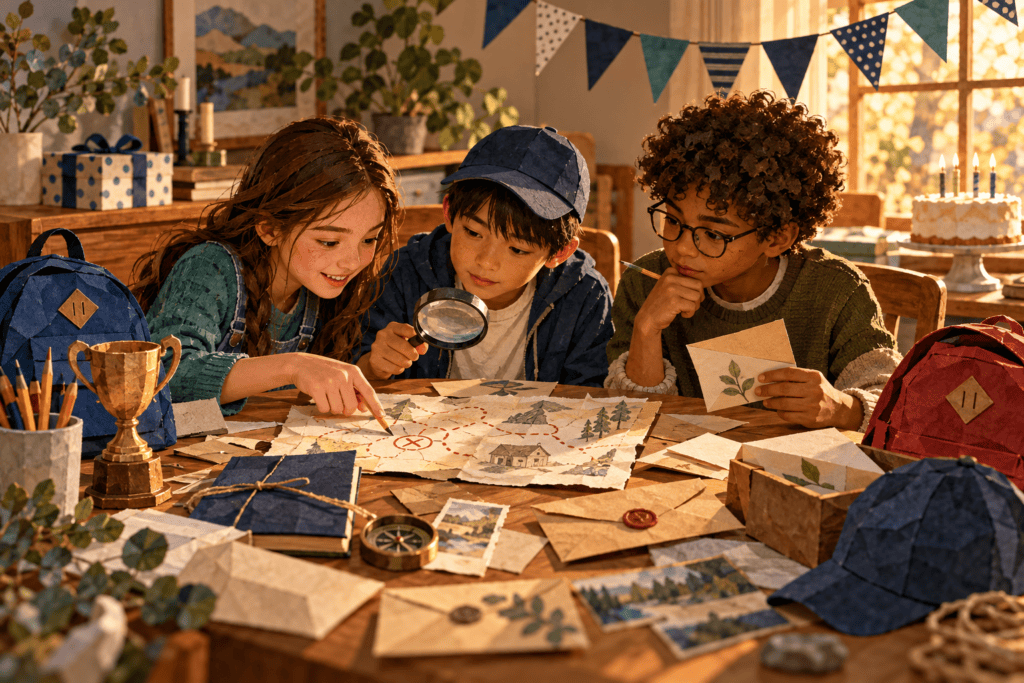
Detective party games for kids turn a birthday table into a place for questions, theories, and a satisfying reveal. You do not need a dramatic crime story or a room full of decorations. A missing trophy, a few clear clues, and one shared goal are enough to begin.
This homemade mini mystery gives children three different jobs: compare evidence, decode a location, and explain their conclusion. Use it at a birthday party, a playdate, or a classroom celebration. Everything below is an original activity you can copy onto paper; it is separate from the Printed Adventures games.
Start with the case of the missing trophy
Read this introduction aloud: “The party trophy has disappeared from its display table. A helper moved it somewhere safe before the guests arrived. Work together to find out who moved it and where it is now.”
Keep the story friendly. Nobody has stolen anything, and no child needs to play the villain. The aim is to explain what happened using evidence.
For a small team, put all the clues in the middle of a table. For a larger party, make duplicate sets so everyone can read and contribute. You will need paper, pencils, three envelopes, and an optional paper trophy. Allow about 20–30 minutes as a starting plan, then adjust to your group. This is a suggested host timetable, not a tested completion guarantee.
Three detective party games for kids
Game one — Compare the helper cards
Write these three cards exactly as shown:
Alex — red bag and cap. Sam — blue bag and cap. Jo — blue bag and no cap.
Then give the team this witness note: “The helper carried a blue bag and wore a cap.” Ask the children to cross out anyone who does not match both details.
A useful question is, “Which clue rules that person out?” Alex has the wrong bag. Jo has no cap. Only Sam matches both facts. Let children explain their reasoning before opening the next envelope.
Game two — Decode the hiding place
Write a simple alphabet key: A=1, B=2, C=3, continuing through Z=26. Under it, write this message:
2–15–24
The answer is BOX. Put three location cards on the table: BOX, DESK, and SHELF. Children use the decoded word to choose the matching card. You can place a paper trophy in an actual box, or keep the whole activity seated and place it beneath the BOX card.
If you use an actual box, choose an accessible place and explain the search boundary before play. Avoid sending children into cupboards, private rooms, or places they need to climb to reach.
Game three — Reconstruct the timeline
Prepare these three event strips:
“First, the trophy stood on the display table.” “Next, Sam put the trophy in a box to keep it safe.” “Finally, the guests arrived and noticed the empty table.”
Mix the strips and ask the team to put them in order. Then invite a detective to complete this sentence: “Sam moved the trophy to the box before the guests arrived.”
This final activity confirms the first two answers rather than introducing a new suspect. That makes the ending clear: the trophy was moved for safekeeping, and the team can explain the evidence.
Give every detective something to do
Try three rotating roles: reader, recorder, and evidence checker. The reader shares a clue aloud, the recorder writes the team’s answer, and the checker asks whether the answer fits every detail. Swap roles after each envelope.
For confident readers, ask for a written case report. For children who prefer speaking, accept an oral explanation or let them point to the matching cards. Keep the clues visible so the activity depends on reasoning rather than remembering a long instruction.
These are screen-free activities for kids that can be played cooperatively. A shared case also avoids eliminating players while everyone else continues. If teams finish at different times, ask early finishers to write a new witness note for Alex or Jo.
Make the party feel like an investigation
Name the table “Detective Headquarters” and place the envelopes beside a pencil cup. A paper badge is optional; costumes and special props are not required. Before starting, show children where the clues are and explain that they do not need to search anywhere else.
Serve snacks after the case is solved, or keep a separate snack station so the paper clues stay usable. Finish with a quick evidence circle: each child shares one fact that helped the team.
For an October party, add a paper pumpkin or a friendly ghost to the invitation. Keep the same gentle mystery underneath. Try the same case at a playdate or during an indoor family afternoon.
Choose a ready to print adventure for the next case
If your detectives want a longer story, Detective Club The Case of the Missing Dog follows Buddy the golden retriever’s disappearance. Designed for ages 8–12, it combines a neighborhood story with puzzles and suspects to cross off. The product page describes a screen-free game that prints at home and requires zero setup.
The trophy activity above is a homemade party idea, not a preview of that game’s pages. For more guidance, read how to set up a printable detective game at home. You can also browse Printed Adventures for printable puzzle games for kids with different adventure themes.
Host answers and helpful hints
Who moved the trophy? Sam: blue bag plus cap matches both details.
Where is the trophy? In the box: 2=B, 15=O, and 24=X.
What happened? The trophy was on display, Sam moved it for safekeeping, and then the guests arrived.
If the team is stuck, reveal one hint at a time. For the helper cards, ask them to check the bag first and the cap second. Then for the code, decode the first number together. And for the timeline, find the strip beginning with “First.”
Ready to try detective party games for kids? Copy the cards, prepare the three envelopes, and let your young investigators explain the case. For their next mystery, explore Detective Club and let a printable story lead the adventure.