
Looking for family game night ideas that do not start with another download, a complicated rulebook, or a pile of supplies? Begin with one short guessing game, then choose a main activity together. A screen-free evening can fit around an ordinary dining table, even when nobody has the energy to organize a big event.
This plan is for families with children ages 8–12. It includes a spoken warm-up you can play immediately, a drawing challenge, and an option for a longer printable puzzle adventure. Choose the version that fits tonight; you do not need to complete every activity.
Make a small plan before you sit down
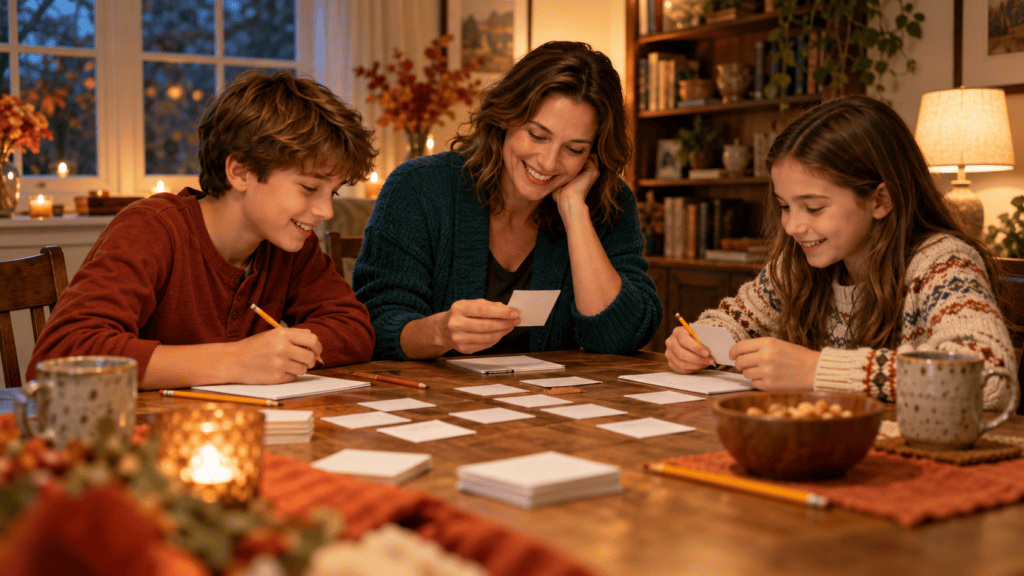
Pick a starting time and an approximate stopping point. For a short evening, try a three-to-five-minute warm-up, ten-to-fifteen minutes on the main activity, and a few minutes to finish. Treat those times as a flexible host plan, not a promise about how long every child will stay interested.
Put plain paper and pencils on the table. Let the children choose between two activities rather than searching through a long list. You might ask, “Would you rather draw something funny or solve something together?”
Agree on the screen-free part as a family. Put entertainment devices aside, including adult phones, while keeping necessary communication or accessibility tools available. You can use a kitchen clock instead of a phone timer. The aim is to make room for a shared activity, not to turn the evening into a test of perfect behavior.
Start with the Three Clue Game
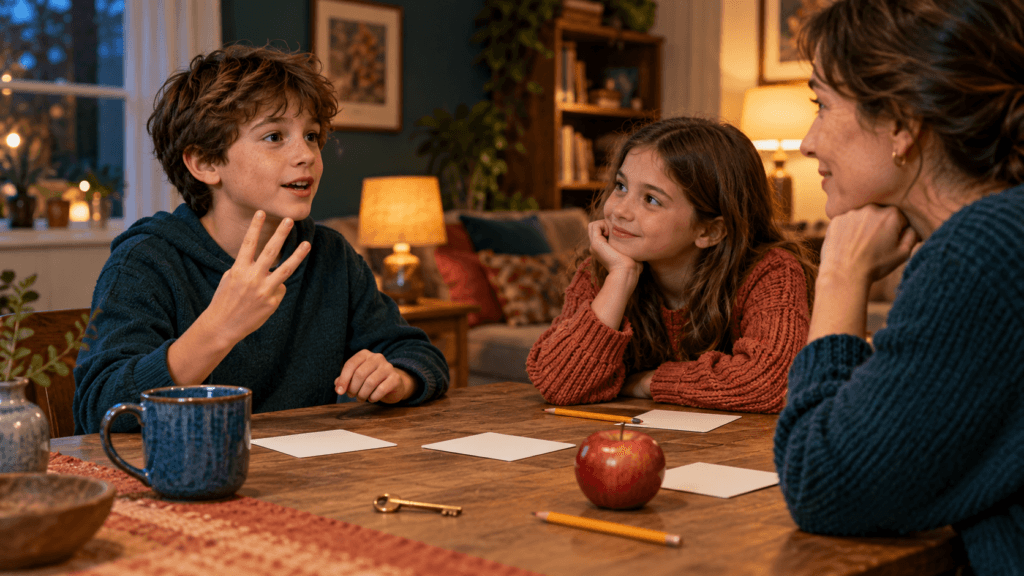
For this quick warm-up, one player thinks of an everyday object. They describe it using three clues without saying its name. Everyone else listens to all three clues before guessing.
Try a ready example
Imagine a mug. The clue giver says:
1. You can hold me by a handle.
2. You can put a drink inside me.
3. You might find me beside a kettle.
The other players can guess “mug” or “cup with a handle.” Accept an answer that fits the description rather than arguing over a single word. Then change the clue giver so a child gets to lead the next round.
Adjust the challenge together
If choosing an object is difficult, put a mug, a key, and an apple on the table. The clue giver secretly chooses one of those three. This smaller set makes the first round easier to understand.
For a harder round, remove the objects and choose a category such as kitchen items or things in a school bag. Ask the clue giver to start with a broad clue and make the final clue more specific. If two answers fit, discuss what extra detail would separate them. There is no need to keep score.
Family game night ideas for a shared main activity
The warm-up gets everyone taking turns. Now choose an activity with enough substance to become the main event. These family game night ideas offer different ways to participate, so pick the one your group is most curious about.
Play Draw and Describe
Give each person paper and a pencil. One player becomes the designer and quietly draws a simple imaginary creature. They then describe it while everyone else draws, without showing the original picture.
Try this first-round description: “Draw a large rectangle for the body. Add two round eyes near the top. Put three triangle feet along the bottom. Draw one curly antenna above the body.” Read one instruction at a time and let everyone ask questions.
When the drawings are finished, reveal them together. Compare which details matched and which instructions people understood differently. Different-looking creatures are part of the fun; this is not an art competition. Swap designers for the next round, or let someone describe a creature aloud without drawing a hidden original.
Work on a puzzle as one team
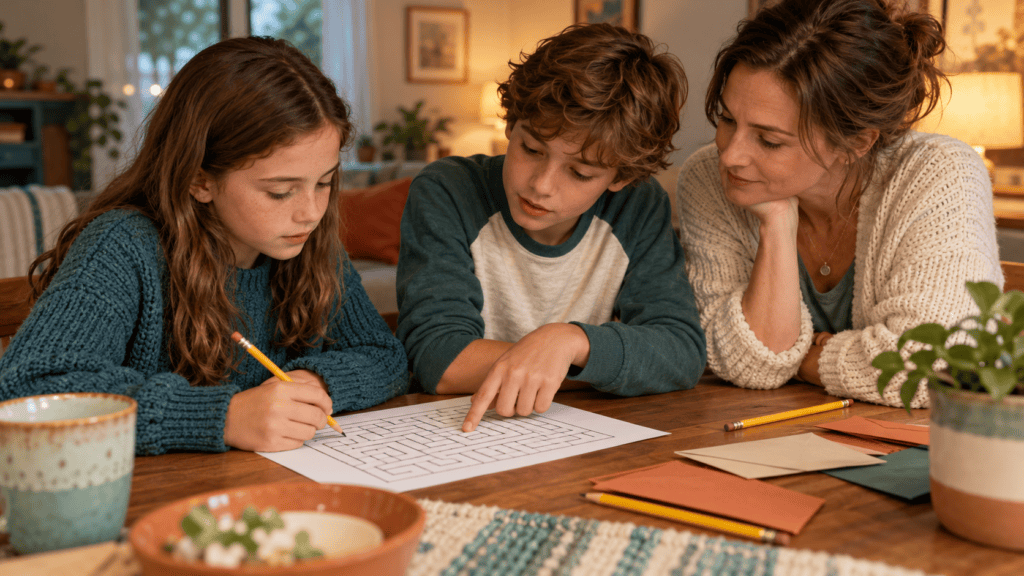
Choose a puzzle you already own or a printed activity you have permission to use. Read the goal aloud before anyone starts. Keep the page where every player can see it, and rotate the pencil rather than letting the quickest solver complete everything.
Try two simple jobs: one person suggests the next step, and another checks whether it fits the instructions. Swap jobs after each puzzle. An adult can read longer passages while a child tracks clues or explains the team’s answer.
Our screen-free activities for kids ages 8–12 guide has more ideas for evenings when your family would rather build, move, or create.
Make room for a longer mystery another night
If your children enjoy connected clues, story-based printable puzzle games for kids offer another way to plan the main activity. Set aside the warm-up games if you want to spend the available time on the story.
For an October option, Ghost Hunters The Whispering Manor is a printable mystery for ages 8–12. Players explore the manor’s puzzles and collect letters to reveal the phantom’s name. The download includes an answer sheet and a Ghost Hunter certificate, and the pages need no cutting or assembling.
Check the preview together if anyone is unsure about a ghost theme. Choose another adventure if a haunted setting does not appeal to your child. The Printed Adventures collection also includes detective, spy, pirate, wizard, and temple themes.
The guessing game and drawing activity in this article are homemade family games. They are not sample puzzles from Ghost Hunters or another paid download.
Keep everyone in the game
Agree that people can ask for help and pass on a turn. If one player needs more time, let them finish a thought before someone else answers. When an adult spots the solution first, try asking, “Which detail should we look at next?” instead of announcing it.
If the group becomes frustrated, pause for a stretch or finish the round early. You can leave a longer puzzle for another day. A useful ending is simple: everyone names one moment they enjoyed, then the children choose which activity they would like to repeat.
Save a simple plan for next time
Keep paper and pencils together so the next invitation is easy to act on. Let a different family member choose the warm-up or become the designer next time. Your family game night does not need a new theme every week.
Start tonight with the Three Clue Game. If your team wants a story to solve next, explore Ghost Hunters and choose a night for a printable mystery adventure.